Posts

Showing posts with the label Britain

Book Review - Entwined Histories: Essays on Poland, Britain and Cultural Memory

Image
AD - this book was kindly sent to me in exchange for an honest review.   Entwined Histories is a collection of essays written by diplomat, scholar, and author, Piotr Wilczek. As the title suggests, the essays aim to highlight the shared history between Poland and Britain, something that hasn’t been written about extensively before. Rather than focussing on the more typical connections between the two nations, such as official policy and visits, Wilczek takes a unique approach by drawing attention to the reality of diplomacy, including conversations, observations, food, culture, and more. Each section of the book explores a different theme, such as traditions, shared histories, literature, and faith.  Wilczek argues that diplomacy is shaped by personal encounters and conversations and not just policies and treaties, with a great deal of diplomacy actually taking place under the radar and not just via official processes. He focuses on how the everyday life and interactions of di...

The History of The Old Man of Coniston

Image
  May is National Walking Month so I wanted to share with you the history behind a recent walk I did. The Old Man of Coniston (or Coniston Old Man) is located in the Lake District and is one of the fells in the Furness Fells . It is approximately 2632.61 ft high. The road up to the main car park for the hike was originally built to serve the slate quarry . The Coniston Old man has an extensive slate mining history dating back to 12th and 13th centuries. It was estimated that around this time slate began to be worked here and has been worked up until the present day. By the 1500s, established slate workings were present in the area. On the stony path on the way up to the summit, you can see numerous signs of the remnants of the slate industry from buildings and machinery to electrical pylons.   The summit itself is signified by a slate platform and cairn. Although this is a great spot to have lunch if the weather is good, the summit was historically used as a warning be...

Spotlight On: Amy Johnson, Breaking Records in Aviation

Image
Source: Amy Johnson Arts Trust  Amy Johnson was an aviation pioneer who broke a series of flight records throughout the 1930s but is most well known for being the first woman to fly solo from England to Australia in 1930.  A Growing Love for Aviation Born in 1903 in Kingston-Upon-Hull, England Amy had no obvious background in flight. Her father ran a fish import and export business and she studied Economics at Sheffield University. She moved to London and worked as a typist for a solicitors firm. In an attempt to rid herself of boredom, one day Amy hopped onto a bus to take a visit to the Stag Lane Aerodrome in North London. Captivated by watching the biplanes take of and land, Amy found herself spending more and more time there.   Johnson gained her Pilot's A licence and her Ground Engineer's C licence in 1929, becoming the first woman in the UK to gain the engineer's licence of this type. Johnson traded in her secretarial job for a full time engineering role at the...

15th Earl of Derby, Edward Henry Stanley

Image
 Edward Henry Stantley by Maull and Polybank August 1858 NPG Ax7308 © National Portrait Gallery, London Today we're going to have a look at an individual that you have most likely never heard of. When looking at 19th Century British politics and foreign policy, he certainly isn't the first person that you springs to mind but I personally find him to be an interesting figure. Today we are going to have a look at Edward Henry Stanley (1826 - 1893), the Fifteenth Earl of Derby. When researching Derby, you get the feeling that those around him thought that he was a bit of an odd character. Upon further inspection it appears that Derby acted in his own unique way during his decision, emphasising pragmatism over the prestige of the British Empire. So who is Derby? He was born to Edward Smith Stanley 14th Earl of Derby (of course), who served as a Conservative Prime Minister between 1866-1868 so it's safe to say that Derby was born into politics and foreign affairs. He ...

British Nuclear Weapons: Part 1 Development

Image
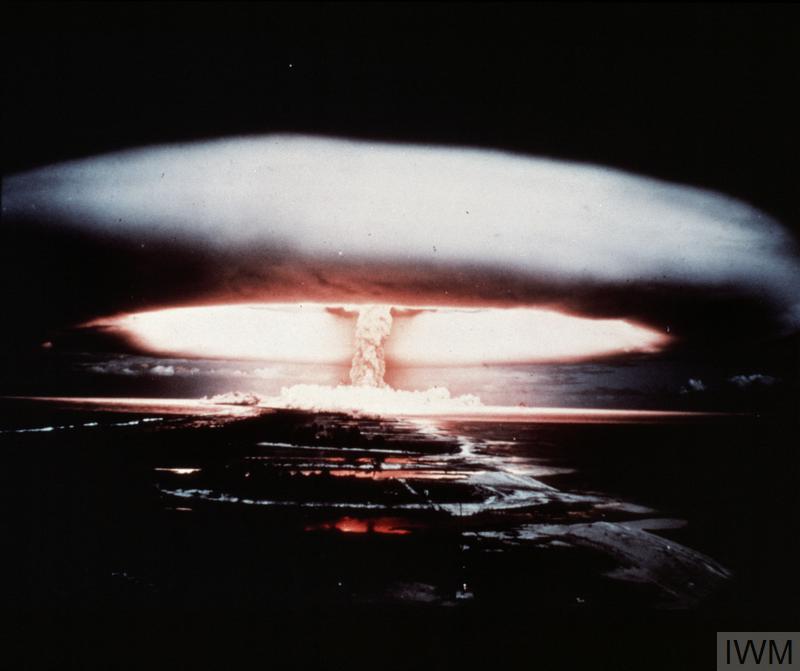
British Nuclear Tests in 1950s © IWM (TR 65682B) When we think about nuclear weapons we tend to think immediately of the USA and Russia, the two major players during the Cold War. As a result, Britain's own nuclear programme is often overlooked. In this three part series, we are going to take a look at the development of British nuclear weapons from the creation of British nuclear bombs and the V-Bomber Force to Polaris and Chevaline and lastly to the current Trident system. The Early Days  Britain was one of the first countries to look into the developments of atomic energy. In 1917, British physicist, Ernest Rutherford was the first person to split the atom which ignited curiosity of what this could lead to.  By 1939, the discovery of nuclear fission introduced the concept of nuclear energy and also nuclear weapons.  Photograph of Churchill, Truman and Stalin at the Yalta Conference, 1945. (The National Archives Catalogue ref: CO 1069/892) Second Wo...

Winston Churchill and The Russian Civil War

Image
Winston Churchill © IWM (Q 34664) In 1917, the Tsar of Russia and his family were murdered and overthrown by the Bolsheviks. What followed was the Russian Civil War where various factions including the Bolsheviks (Reds) and anti-Bolsheviks (Whites) fought for power over their country. Fearful of the relatively new idea of Communism, the Allies (Britain, France and USA) generally supported a White victory. Winston Churchill, Secretary of State for War, also followed this view favouring extensive intervention against the Bolsheviks. But where Churchill's views regarding the Civil War correct and the most beneficial for Britain? Key Terms : Bolsheviks (Red): Started the Revolution in 1917 and overthrew the Tsar, withdrew Russia from WW1. Anti-Bolsheviks (Whites): Largely ex-military and supporters of the Tsar who wanted to keep Russia in WW1.  What Were the British Aims During The Russian Civil War? Following the collapse of Tsarist Russia and consequential withdrawal from ...